Adhesion Promoters for Coatings: The Complete Guide
Why coatings delaminate on metals, plastics and repainted surfaces, how coupling agents build a chemical bridge between film and substrate, which chemistry matches which surface, and how to formulate and test adhesion reliably.
Why coatings delaminate on metals, plastics and repainted surfaces, how coupling agents build a chemical bridge between film and substrate, which chemistry matches which surface — silanes, titanates, phosphates, chlorinated polyolefins — and how to formulate and test adhesion without relying on luck.
Adhesion Is the Foundation of Every Coating Property
Corrosion resistance, chemical resistance, weatherability, scratch resistance — every property in a coating specification is measured on a film that is still attached to its substrate. If the film delaminates, the specification no longer matters.
Adhesion promoters — also called coupling agents — build a molecular bridge between the coating and the substrate. They convert a weak physical attachment into a strong chemical or physicochemical bond that survives water, humidity and thermal cycling.
When an adhesion promoter is essential:
- Metal substrates: galvanized steel, aluminium, zinc, stainless steel
- Low-energy plastics: polypropylene, polyethylene, nylon
- Repainted and refinish surfaces: aged coatings, powder-coated parts
- Wet or immersion service: marine, tank linings, exterior metal
- Coil coating and can coating, where forming follows painting
Adhesion promoters do not replace surface preparation. They are the second line of defence: preparation removes the weak boundary layer, and the promoter builds the bond on top of a clean surface.
How a Coupling Agent Works
A coating without a promoter adheres mechanically: the wet film flows into the roughness of the substrate, cures, and locks into the texture. This bond is physical, and water molecules are small enough to creep between the film and the substrate and slowly displace it.
An adhesion promoter has two functional ends:
- The substrate-reactive end — hydrolyses and bonds to the surface: silanol groups to metal hydroxide layers, carboxyl groups to metal oxides, specific groups to plastic surfaces
- The coating-compatible end — reacts with or entangles in the resin matrix: epoxy, amino, methacrylic or vinyl functionality
The result is a covalent bridge across the interface. Water can no longer push the film off, because the film is chemically part of the surface.
Why the test must include water: the classic failure pattern is good dry adhesion and delamination after immersion. A physical bond survives the crosshatch test but not the water bath. A chemical bond survives both.
The Chemistry Families
Silanes — the Universal Coupling Agents
Silane coupling agents have the structure R'–Si(OR)₃. The alkoxy groups hydrolyse to silanols that bond to inorganic surfaces; the organic group R' reacts with the resin.
| Silane type | Functional group | Resin match |
|---|---|---|
| Amino silane | –NH₂ | Epoxy, PU, melamine, acrylic |
| Epoxy silane | –epoxy | Epoxy, acrylic, PU |
| Methacryloxy silane | –methacrylate | UV, acrylic, polyester |
| Vinyl silane | –vinyl | Peroxide cure, polyethylene |
Strengths: proven technology, effective on metals, glass, ceramics and fillers; can be added to the paint or used as a primer.
Limits: need moisture to hydrolyse — the same moisture can reduce storage stability; self-condensation causes gelation; weak on non-polar plastics.
Epoxy- and Amino-Functional Products for Reactive Systems
Many adhesion promoters combine a silane anchor with epoxy or amino functionality so they participate in the curing reaction of the coating itself. In thermosetting systems — melamine, polyurethane, epoxy — the promoter crosslinks into the network and becomes inseparable from the film.
Strengths: strong contribution to intercoat adhesion and to wet adhesion; compatible with the most common industrial binders.
Limits: the reactive group must match the resin; wrong pairing wastes the functionality.
Titanates and Organometallic Coupling Agents
Organotitanium compounds bond through Ti–O bridges and become reactive at elevated temperature (typically from 60 °C), reacting with the carboxyl and hydroxyl groups of the substrate.
Strengths: effective on a wider range of substrates, do not require hydrolysis, improve heat resistance and can also aid pigment dispersion.
Limits: higher cost, temperature activation, less familiarity among formulators.
Chlorinated Polyolefins — for the Hardest Plastics
Polypropylene and polyethylene have no polar groups and almost nothing to bond to. Modified chlorinated polyolefins were developed specifically for these substrates.
Strengths: the only reliable chemistry class for PP and PE surfaces; available in solvent-borne and waterborne form.
Limits: restricted to polyolefin applications; regulatory attention on chlorinated products in some regions.
Matching the Chemistry to the Substrate
| Substrate | Challenge | Chemistry | Typical product |
|---|---|---|---|
| Steel, galvanized, zinc | Smooth surface, weak oxide/hydroxide layer | Amino silane, epoxy silane, phosphate | PA-308, PA-408, PA-508 |
| Aluminium | Variable oxide, inert anodized surface | Epoxy silane, amino silane | PA-208, PA-808, PA-908 |
| Polypropylene, polyethylene | No polar groups, 20–30 mN/m | Chlorinated polyolefin | PA-1708, PA-1808 |
| Nylon, stainless steel | Hard-to-wet surfaces | Anchor-group polymers | PA-708 |
| Glass, ceramics, fillers | Inorganic surface, hydroxyls | Silane (amino, epoxy, methacryloxy) | PA-508, PA-608, PA-1108 |
| UV-cured coatings | Reaction must happen at cure speed | Unsaturated-bond silanes | PA-108, PA-1008, PA-1108 |
| Repaint / intercoat | Smooth crosslinked old film | Reactive promoter, co-crosslinking | PA-1208, PA-1308, PA-1508 |
The single most common mistake is buying "an adhesion promoter" without defining the substrate first. The chemistry that bonds to galvanized steel does nothing on polypropylene, and vice versa.
Dosage and Addition
Addition Methods
Option A — add to the coating (most common):
- Typical addition 0.5–3.0% on total formulation
- Add with good agitation, early enough to homogenise
- In water-based systems, add the silane late and control pH to limit hydrolysis
- Verify storage stability at 40 °C for 30 days before release
Option B — use as a primer layer:
- Apply as a thin wash coat, diluted 5–20% in solvent
- Flash off or partially cure before the topcoat
- More reliable on difficult substrates, at the cost of an extra process step
- Chlorinated polyolefins for PP are usually used this way
Dosage Ranges
| Chemistry | In-coating dosage | As primer |
|---|---|---|
| Silane | 0.5–2.0% | 5–20% in solvent |
| Reactive (epoxy/amino functional) | 0.5–3.0% | Per product data sheet |
| Titanate | 0.3–1.5% | Rarely used as primer |
| Chlorinated polyolefin | — | 5–20% in primer |
Storage Stability: the Silent Failure
Silanes hydrolyse in the can. In a water-based paint, a poorly stabilised silane slowly self-condenses until the batch gels or the adhesion improvement disappears.
Rules that prevent this:
- Add the silane as late as possible in production
- Keep pH in the stable window (typically 4–6 for amino silanes in water)
- Use water-stable grades for aqueous systems (PA-908 is designed for long stability in water)
- Store and test at 40 °C for 30 days — if adhesion survives this, the product is release-worthy
Testing Protocol: How to Prove the Promoter Works
Adhesion must be tested in the environment the coating will actually serve. A dry crosshatch is only the first step.
| Test | Conditions | Pass criterion |
|---|---|---|
| Crosshatch, dry | 2 mm grid, tape pull | Gt 0–1 |
| Crosshatch after water | 24 h immersion, 2 h recovery | Gt 0–1, no blistering |
| Humidity resistance | 500 h at 40 °C / 95% RH | No delamination at grid |
| Thermal cycling | 10 cycles –20 °C to +60 °C | No cracking or loss at grid |
| Solvent resistance | Gasoline / MEK rub, 100 rubs | Film intact, adhesion intact |
The comparison that matters: run every test on three panels — no promoter, promoter at your dose, promoter at double dose. If the promoter does not improve the wet or cycled result, the chemistry is wrong for this substrate and no dose increase will fix it.
Common Failures and Their Real Causes
| Symptom | Cause | Fix |
|---|---|---|
| Good dry adhesion, fails after water | Physical bond only, water at the interface | Switch to a reactive silane; increase crosslink density |
| Gelation in water-based paint | Silane hydrolysis and self-condensation | Use a water-stable grade, add late, control pH |
| Batch-to-batch variation | Substrate condition varies (oxide, contamination) | Standardise pretreatment; use the promoter as insurance, not replacement |
| No improvement after adding | Wrong chemistry for the substrate | Match chemistry to surface (silane for metal, CPO for PP) |
| Adhesion on PP still fails | CPO used as additive instead of primer | Use CPO as a primer layer; verify surface energy |
| Recoat failure on old coating | Smooth crosslinked surface, no anchor | Scuff, clean, use a co-crosslinking promoter |
ASTRA PA® — Adhesion Promoters for Coatings
ASTRA PA® covers the full spectrum: silanes, reactive epoxy/amino products, titanates and chlorinated polyolefins for solvent-borne, waterborne and UV-cured systems.
Silanes and reactive coupling agents:
| Product | Comparable to | Active | System | Key feature |
|---|---|---|---|---|
| ASTRA PA-108 | DC-6030 | 100% | O / RC | Unsaturated double bonds, crosslinks in UV systems |
| ASTRA PA-208 | DC-6040 | 100% | O / RC | Epoxy groups, adhesion to inorganic substrates |
| ASTRA PA-508 | DC-6020 | 100% | O | Amino groups, for inorganic substrates and fillers |
| ASTRA PA-608 | Elementis-1121 | 50% | O | Amino groups, processes fillers, co-crosslinking |
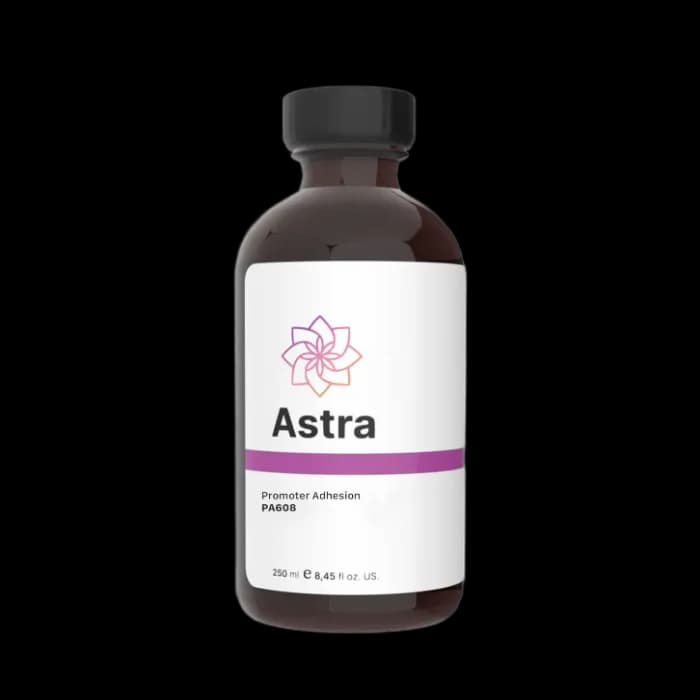
| ASTRA PA-808 | KBM-403 | 100% | O | Epoxysilane, improves adhesion and mechanical strength |
| ASTRA PA-908 | — | 100% | O / WB | Epoxy groups, stable in water for a long time |
| ASTRA PA-1008 | DC-6030 | 100% | RC | Unsaturated bonds, radiation-curing systems |
| ASTRA PA-1108 | PM-2 | 100% | RC | Unsaturated bonds, reacts with resin and inorganic surface |
Thermosetting and wet-adhesion promoters:
| Product | Comparable to | Active | System | Key feature |
|---|---|---|---|---|
| ASTRA PA-1208 | Elementis-ADP | 75% | O / WB | Crosslinks into paintwork, good thermoset compatibility |
| ASTRA PA-1308 | Lubrizol-2063 | 60% | O / WB | Reacts with melamine and NCO, strong metal adhesion |
| ASTRA PA-1408 | TEGO LTW | 60% | O | Improves adhesion, moisture and salt resistance |
| ASTRA PA-1508 | — | 60% | O / WB | Crosslinks into paintwork, thermoset systems |
| ASTRA PA-308 | Lubrizol-2063 | 60% | O / WB | Reacts with melamine and NCO, strong metal adhesion |
| ASTRA PA-408 | Water-borne PA-308 | 60% | O | For melamine thermosets, adhesion to metals |
Specialists — titanate and chlorinated polyolefins:
| Product | Comparable to | Active | System | Key feature |
|---|---|---|---|---|
| ASTRA PA-1608 | Dupont AA-75 | 50% | O | Organotitanium, reactive from 60 °C, bonds –COOH/–OH |
| ASTRA PA-1708 | PP adhesion promoter | 20% | O / RC | Chlorinated polyolefin for PP and PE substrates |
| ASTRA PA-1808 | Water-borne PA-1708 | 30% | WB | Waterborne chlorinated polyolefin for polyolefins |
| ASTRA PA-708 | — | 100% | O | Anchor groups, excels on stainless steel and nylon |
A Simple Selection Sequence
- Define the substrate first. Steel and aluminium → silanes. Polypropylene → chlorinated polyolefin. Nylon or stainless steel → anchor-group polymer. UV system → unsaturated-bond silane.
- Define the system. Solvent-borne, waterborne or radiation-curing — choose the matching grade.
- Decide addition mode. Additive in the paint, or primer layer for difficult plastics.
- Check reactivity. In thermosetting systems choose a grade that co-crosslinks with the resin (melamine, NCO, epoxy).
- Test wet and cycled. Dry crosshatch is not enough — run water immersion and thermal cycling before release.
- Verify storage stability at 40 °C for 30 days for water-based formulations.
All product names, trade names and trademarks mentioned are the property of their respective owners. BYK, TEGO, Surfynol, TROYSOL, Dupont, 3M, Evonik, Elementis, Lubrizol, Silquest and Dow are trademarks of their respective companies. Comparable products are listed for reference only.
Key Takeaways
- Adhesion promoters build a chemical bridge between film and substrate — far stronger than mechanical anchoring alone
- Match the chemistry to the substrate: silanes for metals and glass, chlorinated polyolefins for PP and PE, titanates where heat activation fits
- The promoter supplements, never replaces, surface preparation
- In water-based systems control silane hydrolysis: add late, stabilise pH, use water-stable grades
- Test adhesion after water immersion and thermal cycling — dry adhesion alone is not predictive
- Run a three-panel comparison (none / dose / double dose); if the wet result does not improve, the chemistry is wrong
Testing additives for this application?
Send us your current formulation challenge and our technical team will recommend an ASTRA product package for lab screening.