Reactive Diluents and Functional Additives: The Complete Guide
Why reactive diluents cut viscosity without VOC and become part of the film, how terminal groups — OH, epoxy, amino, acrylate — determine compatibility, and how catalysts, siccatives, coalescents and pH buffers shape the cured film.
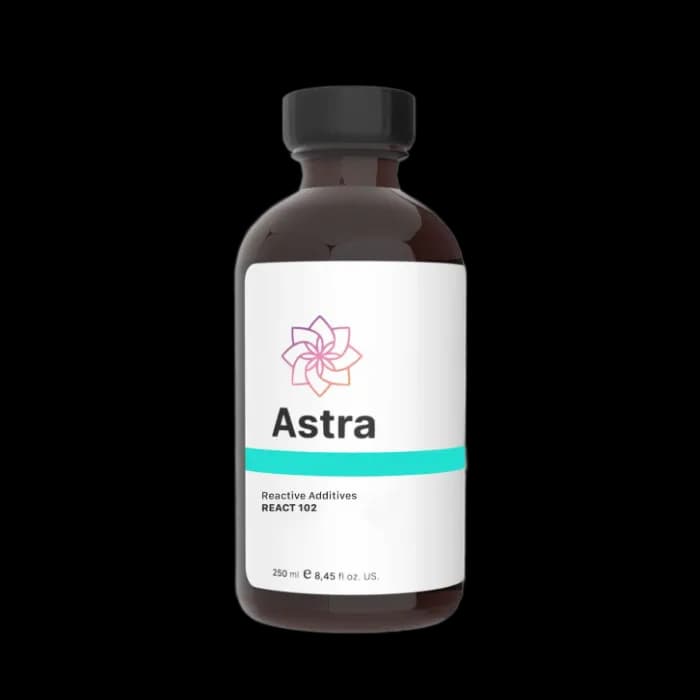
Why reactive diluents and functional additives go beyond conventional additives, how reactive polysiloxanes with OH, epoxy, amino and acrylate terminal groups cut viscosity without VOC and become part of the film, how catalysts, siccatives, coalescents and pH buffers modify the final properties, and how to select them without side effects.
Additives That Become Part of the Film
Most coating additives solve a single process problem: dispersants disperse, defoamers defoam, thickeners thicken. They remain in the film but do not change its chemistry.
Two categories go further. Reactive additives carry functional groups that react into the polymer network during curing — heat, UV or catalyst-driven. Functional additives deliver specific performance properties that the base resin alone cannot provide.
This difference matters in practice: a non-reactive additive can migrate, bleed out or reduce crosslink density. A reactive additive that participates in curing cannot be separated from the film. It is part of the network, permanently.
Reactive Diluents: Viscosity Without VOC
The Problem with Solvent Dilution
In high-solids and solvent-free systems — epoxy, polyurethane, UV-curable — viscosity must be reduced to a workable level. The conventional way is solvent. But every kilogram of solvent:
- Adds VOC and regulatory exposure
- Evaporates, leaving micro-voids in the film
- Reduces crosslink density per unit volume
- Weakens chemical resistance and barrier properties
How a Reactive Diluent Works
A reactive diluent is a low-viscosity monomer or oligomer with functional terminal groups. During curing it reacts into the polymer network, exactly like a resin component.
| Property | Solvent | Reactive diluent |
|---|---|---|
| Reduces viscosity | Yes | Yes |
| Remains in film | No (evaporates) | Yes (crosslinks) |
| Adds VOC | Yes | No |
| Contributes to network | No | Yes |
| Effect on crosslink density | Reduces | Preserves or increases |
Result: application viscosity at low VOC, full crosslink density, and no evaporation voids.
Reactive Polysiloxanes: Chemistry by Terminal Group
The ASTRA REACT® range is built on modified polysiloxanes whose terminal groups determine which resin family they react with. The terminal group is the selection key.
| Terminal group | Reacts with | Best system | Effect |
|---|---|---|---|
| –CH₂OH (carbinol) | Isocyanates (–NCO) | 2K PU, polyurethane | Elasticity, flexibility, weatherability |
| –(OCH₂CH₂)ₙOH (polyether-OH) | Isocyanates (–NCO) | 2K PU, waterborne PU | Elasticity, hydrophilicity, impact strength |
| –CH₂CHOCH₂ (epoxy) | Epoxy resins, amines | Epoxy coatings, flooring | Network modification, adhesion, toughness |
| –CH₂NH₂ (amino) | Melamine, isocyanates, epoxy | Melamine-urethane, epoxy | Crosslinking, adhesion to substrates |
| –C(O)CH=CH₂ (acrylate) | Free radicals | UV / radiation-curing | Slip, mar resistance, network incorporation |
| –CH₂OC(O)C(CH₂)CH₃ (methacrylate) | Free radicals | Acrylate, UV systems | Surface modification, cure participation |
| Two –OH groups | Isocyanates, polyesters | PU, polyester, UV resins | Crosslinking, modification of PU and polyester |
Selection rule: match the terminal group to the curing chemistry of your system. A carbinol-terminated siloxane does nothing in a UV system, just as an acrylate-terminated grade does nothing in a 2K PU that cures by polyaddition.
What a Reactive Siloxane Adds to the Film
In Polyurethane Systems (OH-Terminated Grades)
- Elasticity and flexibility — the siloxane backbone absorbs stress, reducing brittleness in flexible substrates
- Water and salt-fog resistance — hydrophobic siloxane segments improve barrier properties
- Impact resistance — chain mobility dissipates impact energy
In Epoxy Systems (Epoxy-Terminated Grades)
- Resin modification — the diluent reacts with the curing agent, becoming part of the network
- New property profiles — toughness, adhesion, thermal stability
- Lower viscosity at constant solids
In UV / Radiation-Curing Systems (Acrylate-Terminated Grades)
- Slip and mar resistance built into the network, not just the surface
- Permanent modification — no migration, no extractables after cure
- Compatible cure speed — the acrylate group participates in radical polymerisation
In Melamine Systems (Amino-Terminated Grades)
- Crosslinking into the melamine-urethane network
- Adhesion improvement to difficult substrates
ASTRA REACT® — Reactive Additives by System
Polyurethane systems (OH-terminated, react with isocyanates):
| Product | Comparable to | System | Key feature |
|---|---|---|---|
| ASTRA REACT-102 | KF-6000 | O | –CH₂OH terminals, reacts with –NCO, improves elasticity |
| ASTRA REACT-202 | KF-6001 | O | –CH₂OH terminals, reacts with –NCO, improves elasticity |
| ASTRA REACT-302 | KF-6002 | O | –CH₂OH terminals, reacts with –NCO, improves elasticity |
| ASTRA REACT-402 | — | O | –CH₂OH terminals, reacts with –NCO, improves elasticity |
| ASTRA REACT-502 | DC-3667 / DC-8427 | O / WB | Polyether-OH terminals, PU systems, elasticity |
| ASTRA REACT-602 | Momentive-2812 | O / WB | Polyether-OH terminals, PU systems, elasticity |
| ASTRA REACT-702 | Momentive-1162 | O / WB | Polyether-OH terminals, PU systems, elasticity |
Epoxy systems (epoxy-terminated):
| Product | Comparable to | System | Key feature |
|---|---|---|---|
| ASTRA REACT-1102 | — | O | –CH₂CHOCH₂ terminals, reacts with epoxy resins |
| ASTRA REACT-1202 | — | O | –CH₂CHOCH₂ terminals, epoxy resin modification |
Melamine-urethane and reactive modification:
| Product | Comparable to | System | Key feature |
|---|---|---|---|
| ASTRA REACT-1302 | KF-8012 | O | –CH₂NH₂ terminals, melamine-urethane systems |
Acrylate systems:
| Product | Comparable to | System | Key feature |
|---|---|---|---|
| ASTRA REACT-1402 | KF-2012 | O | Methacrylate terminal group, acrylate resin modification |
UV / radiation-curing systems (acrylate-terminated):
| Product | Comparable to | System | Key feature |
|---|---|---|---|
| ASTRA REACT-1002 | — | RC | –C(O)CH=CH₂ terminals, radiation-curable resin modification |
| ASTRA REACT-802 | — | O / RC | –C(O)CH=CH₂ terminals, radiation-curable systems |
| ASTRA REACT-902 | — | O / RC | –C(O)CH=CH₂ terminals, radiation-curable systems |
Polyurethane, polyester and UV resins (diol-type):
| Product | Comparable to | System | Key feature |
|---|---|---|---|
| ASTRA REACT-1502 | — | O / RC | Two –OH groups, modification of PU, polyester and UV resins |
Dosage and Formulation Guidelines
| Parameter | Recommendation |
|---|---|
| Typical dosage | 0.5–3.0% on total formulation |
| Addition | Post-letdown with agitation, or during grind for reactive grades |
| Reactivity match | Diluent cure rate must match base resin — too fast gives uneven cure, too slow gives a soft surface |
| Compatibility | Test for haze or phase separation, especially with high-MW resins |
| Mechanical properties | Higher levels reduce Tg and hardness — verify impact and flexibility |
| Storage | Reactive grades react with moisture — keep containers sealed |
The 7/28-day rule: measure hardness development at 7 and 28 days. Some reactive systems continue crosslinking for weeks; a film that feels soft at day 7 may reach full hardness by day 28 — and the reverse also happens when the diluent slows the network.
Functional Additives: Performance in the Cured Film
Functional additives remain active in the cured coating. The ASTRA F® range covers catalysts and siccatives, coalescents, pH buffers, antistatics and conductivity modifiers.
Catalysts and Siccatives — Controlling Cure and Drying
| Product | Comparable to | System | Key feature |
|---|---|---|---|
| ASTRA F-1009 | Catalyst for water-borne alkyd | WB | Organometallic siccative, accelerates drying of water-based alkyds |
| ASTRA F-109 | Cytec-4040 | O / WB | High catalytic efficiency, elasticity, moisture and salt-fog resistance |
| ASTRA F-209 | King-1051 | O / WB | High catalytic efficiency, elasticity, salt-fog resistance |
| ASTRA F-309 | DMEA | O / WB | Drying accelerator, improves hardness, chlorinated esters |
| ASTRA F-409 | — | O / RC | Sulphonic acid catalyst for melamine systems, water and salt-fog resistance |
| ASTRA F-709 | King-5225 | O | Lowers crosslinking temperature, raises density, gloss and hardness |
| ASTRA F-809 | King-2500 | O | Lowers crosslinking temperature, raises density, gloss and hardness |
| ASTRA F-909 | King-2500 | O / WB | High catalytic efficiency, elasticity, moisture resistance |
Selection principle: catalysts are system-specific. A melamine catalyst does nothing useful in an alkyd, and a water-borne siccative is not designed for solvent-borne. Match the catalyst family to the crosslinking chemistry.
Coalescents — Film Formation Without Cracking
| Product | Comparable to | System | Key feature |
|---|---|---|---|
| ASTRA F-1109 | — | WB | Low-evaporation solvent, coalescent for water-based systems |
| ASTRA F-1209 | — | WB | Solvent blend, low evaporation, coalescent function |
Coalescents soften the polymer particles during film formation so they fuse into a continuous film, then evaporate slowly. The balance is: enough coalescence for film integrity, low enough evaporation for open time — without overdosing, which softens the final film.
pH Buffers — Stability of the Whole System
| Product | Comparable to | System | Key feature |
|---|---|---|---|
| ASTRA F-1509 | — | WB | High buffer capacity, neutralises associative thickeners |
| ASTRA F-1609 | AMP 95 | WB | Long-term pH stabilisation, improves frost resistance |
In water-based formulations, pH drift changes thickener efficiency, pigment dispersion stability and can trigger bacterial growth. A buffer keeps the system in its stable window — especially important with associative thickeners that are pH-sensitive.
Antistatics and Conductivity Modifiers
| Product | Comparable to | System | Key feature |
|---|---|---|---|
| ASTRA F-509 | BYK-ES80 | O / RC | Quaternary amine compound, improves antistatic properties |
| ASTRA F-609 | — | O | Ammonium salt, increases conductivity, electrostatic spraying |
For solvent-borne systems applied by electrostatic spraying, consistent conductivity is a process requirement — too low and the paint will not charge, too high and it risks arcing.
Agro-Sector Specials
| Product | Comparable to | System | Key feature |
|---|---|---|---|
| ASTRA F-1309 | Silwet 408 | WB | Improves wetting, uniform distribution of treatment products |
| ASTRA F-1409 | Solvay T/36 | WB | Dispersant for agro products, good compatibility |
Common Formulation Errors
Error 1: Mismatching the Reactive Terminal Group
Result: The diluent does not react — it stays as plasticiser, softening the film and bleeding to the surface. Fix: Match the terminal group to the curing chemistry: OH for isocyanates, epoxy for epoxy-amine, acrylate for radical cure.
Error 2: Adding a Catalyst for the Wrong System
Result: No effect, or worse — premature gelling in the pot. Fix: Verify the catalyst family against the resin chemistry and the bake schedule before scaling.
Error 3: Overdosing a Reactive Diluent for Viscosity
Result: Soft film, low hardness, poor chemical resistance. Fix: Stay in the recommended range; combine with a true viscosity management strategy if needed.
Error 4: Using a Coalescent to Fix a Thickening Problem
Result: Over-softened film, blocked open time, slow dry. Fix: Use the right tool: pH buffer for associative thickener drift, coalescent only for film formation.
Error 5: Ignoring Moisture Sensitivity of Reactive Grades
Result: Premature reaction in the can, shelf-life collapse. Fix: Seal containers, avoid water contamination, add reactive grades late.
A Simple Selection Sequence
- Define the goal. Lower viscosity → reactive diluent. Faster drying → siccative or catalyst. Film formation → coalescent. Stability → pH buffer. Electrostatic application → conductivity modifier.
- Define the system. Waterborne, solvent-borne, radiation-curing — choose the matching grade.
- Match the terminal group. PU → OH-terminated. Epoxy → epoxy-terminated. UV → acrylate-terminated. Melamine → amino-terminated.
- Check compatibility. Test haze, phase separation and storage stability before scaling.
- Verify cure behaviour. Run the 7/28-day hardness test and compare against the control.
- Test final film properties — chemical resistance, flexibility, adhesion — not just viscosity.
All product names, trade names and trademarks mentioned are the property of their respective owners. BYK, TEGO, Surfynol, TROYSOL, Dupont, 3M, Evonik, Elementis, Lubrizol, Silquest, Dow, Momentive, KF, Cytec, King, Silwet, Solvay and AMP are trademarks of their respective companies. Comparable products are listed for reference only.
Key Takeaways
- Reactive additives react into the polymer network — they cannot migrate, bleed or be extracted from the film
- Reactive diluents cut viscosity without VOC and preserve or increase crosslink density
- The terminal group is the selection key: OH for PU, epoxy for epoxy, acrylate for UV, amino for melamine
- Catalysts and siccatives are system-specific — match them to the crosslinking chemistry
- Coalescents and pH buffers solve different problems: film formation vs system stability
- Reactive grades are moisture-sensitive — sealed storage and late addition extend shelf life
- Verify with the 7/28-day hardness test and full film properties, not just viscosity reduction
Testing additives for this application?
Send us your current formulation challenge and our technical team will recommend an ASTRA product package for lab screening.