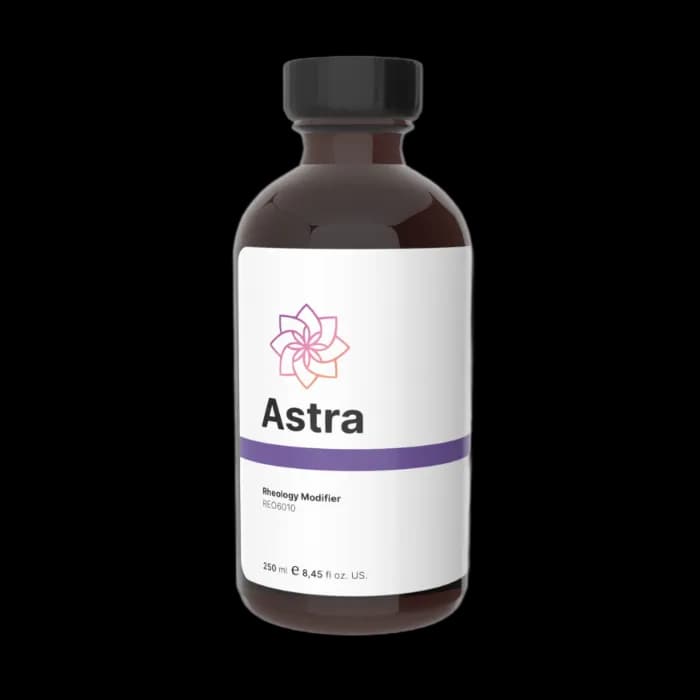
ASTRA REO®
Rheology Modifiers
Rheology additives for precise viscosity tuning in solvent-borne, waterborne, and solvent-free systems. Prevent sedimentation, separation, ensure controlled flow and sag resistance.
Why do we use rheology modifiers?
Rheology modifiers fine-tune the viscosity profile of coatings, inks and adhesives. They prevent sedimentation, separation and sagging while ensuring controlled flow during application. The right rheology enables thicker, more uniform films that resist running on vertical surfaces.
Key Benefits
- Sag Resistance — prevents drips on vertical surfaces
- Anti-Settling — keeps pigments and fillers suspended
- Thixotropic Behavior — flow when applied, set when at rest
- Wide pH Tolerance — works in alkaline and acidic systems
- Compatible with Solvent, Water, UV systems
- Improved Storage Stability
Impact on Coating Performance
Proper rheology control transforms formulations into reliable, easy-to-apply products. ASTRA REO additives reduce waste, improve application speed and produce consistent film thickness across complex geometries.
O – organosoluble, WB – water-based, UV – radiation-curable
Product Catalog
Download TDS| Active % | Feature | TDS | Samples | |||
|---|---|---|---|---|---|---|
| ASTRA REO-13010 | Hemings 105A | Water-based | 50% | Prevents settling of fillers and pigments and prevents runoff of water systems. Works in a wide pH range. | ||
| ASTRA REO-14010 | BYK-8421 | Water-based | 20% | EVA wax emulsion, imparts thixotropic rheology to the system. Affects the orientation of metallized pigments in the film. | ||
| ASTRA REO-15010 | BYK-R605,BYK-405 | Solvent-based / Radiation-curable | 50% | Prevents settling of fillers and pigments and prevents paint and varnish from flowing. May enhance the effect of pyrogenic silicon dioxide. | ||
| ASTRA REO-16010 | BYK-R607 | Solvent-based / Radiation-curable | 65% | Prevents settling of fillers and pigments and prevents paint and varnish materials from flowing. May enhance the effect of pyrogenic silicon dioxide. | ||
| ASTRA REO-17010 | Acrysol DR 72 (low viscosity) | Water-based | 30% | Associative acrylic thickener, provides pseudoplastic rheology. The thickener is effective at pH 7-9. | ||
| ASTRA REO-21010 | — | Water-based | 30% | Alkaline-swellable acrylic thickener, provides pseudoplastic rheology. The thickener is effective at pH 7-9. Provides system stability during storage. | ||
| ASTRA REO-24010 | — | Solvent-based | 75% | Rheology modifier for solvent systems of medium polarity. Applicable for transparent systems. | ||
| ASTRA REO-3010 | BYK-420 | Water-based | 50% | Prevents settling of fillers and pigments and prevents runoff of aqueous systems. Easily dispersed, has a strong effect on rheology. Thixotropic rheology. | ||
| ASTRA REO-5010 | Disparlon AQ-800 | Water-based | 20% | Pre-dispersed polyamide wax, easy to incorporate into the system. Prevents sedimentation and system runoff, used in transparent varnishes. | ||
| ASTRA REO-6010 | RM-2020 | Water-based | 20% | Prevents settling of fillers and pigments and prevents runoff of water systems. Works in a wide range of pH. Agglomerative thickening, ensures alignment. l yagountovokilakov. |
Articles about ASTRA REO®
Formulators' Lab to Plant Playbook for Pigment Dispersion plus DLS
Formulators' Lab to Plant Playbook for Pigment Dispersion plus DLS ! Pigment dispersion laboratory title card illustration Most pigment dispersion issues trace back to one of four culprits: poor wetting, a dispersant mismatch or dosage error, letdown solvent stripping the dispersant off the pigment…
Read
Coating Chemists: 4-Step Lab Diagnosis for Flooding and Floating
Coating Chemists: 4-Step Lab Diagnosis for Flooding and Floating ! Coating defect diagnosis title card illustration Flooding is a uniform surface color shift caused by vertical pigment migration during film formation, while floating produces streaks or mottled patches from horizontal pigment separat…
Read
What Causes Color Strength Loss in Coatings and Inks
What Causes Color Strength Loss in Coatings and Inks ! Decorative title card illustration for chemical coatings article Color strength loss is the measurable reduction in a pigment's tinting power, whether the culprit is poor dispersion, flocculation, a shift in pigment crystal phase, or damage from…
ReadNeed technical assistance?
Our team can help you select the right additive for your formulation.
Contact Technical Support